Showing posts with label figurehead. Show all posts

Sunday, 14 June 2020

Coastal Terrain


Making Good Use of the Things That We Find


The missus ordered a flat pack cabinet thingy recently and it came with so much polystyrene packaging that I felt compelled to try and make use of some of it. These modular terrain pieces were a bit of a learning experience and are not what you'd call durable, but given that they only a took a weekend to make, including drying time, and cost virtually nothing, I don't much care if they fall to bits in a few months time.

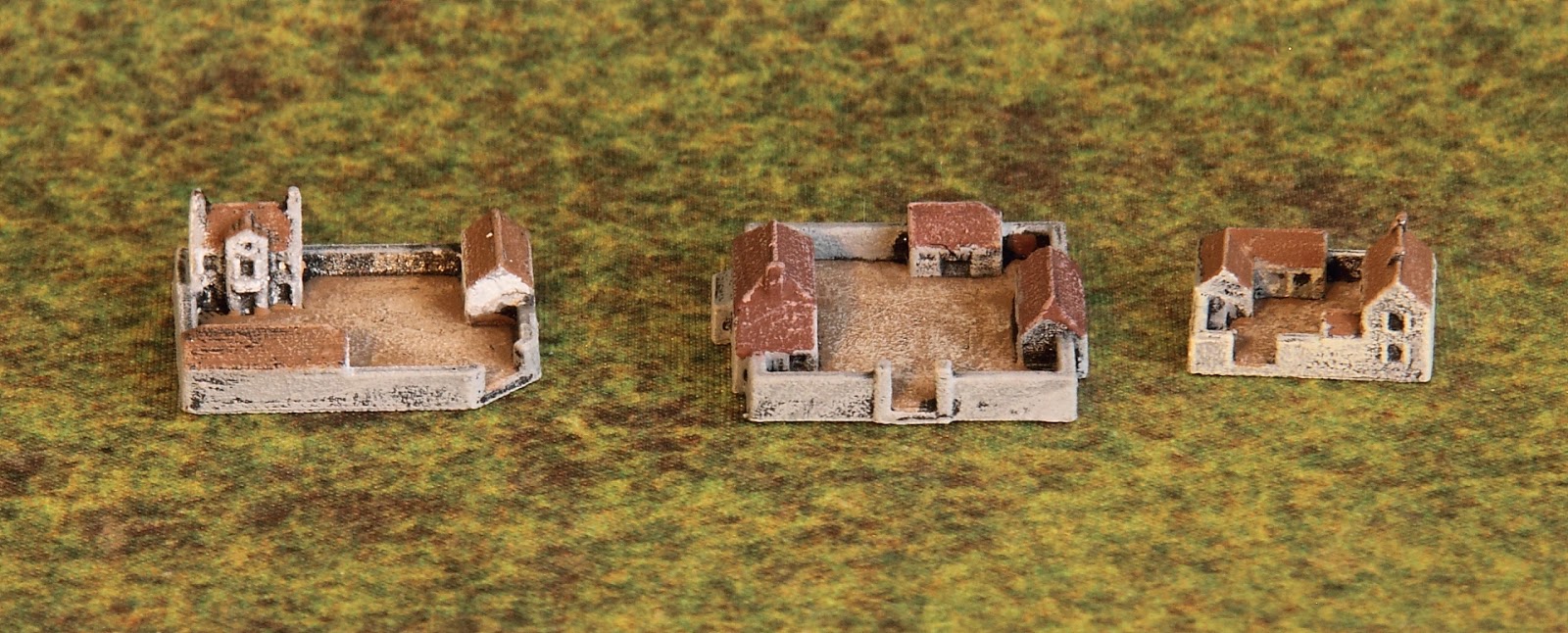
Doing these spurred me on to finish up some of the Brigade Models buildings that I've had sitting around for a while. They're about 1/1000 scale but mostly seem to look fine when placed against 1/2400 ships.

All the sections laid out.
A Spanish squadron of galleys and galleons raids the English coast.
The Henry Grace a Dieu leading a small English squardon with St Mawes castle in the background.
Tudor village.
Southsea Castle. Yes, it is facing the wrong way. Oops.
17th/18th century star fort.
Busy shipping lanes! Late 19th Century merchant ships.
An 1870s large merchant steamer near rocky shoals. The lighthouse is by Figurehead and is true 1/2400.
19th Century (specifically ACW) gun batteries in earthworks on a headland. The batteries are Tumbling Dice 1/2400. I did these ages ago and based them on 2mm MDF, so they look a bit clunky. I may get some more at some point and base them on plastic card so they sit better.
At a pinch, if you squint a bit, the island pieces work ok as Pacific islands in 1/6000.
Sir Monty Drake, on seeing the Spanish fleet approaching, decides there is plenty of time to finish his game of bowls. And maybe have a bit of a nap.

Friday, 28 February 2020

Ye Olde Shyppes

16th Century Ships in 1/2400


I thought I'd share a project I've had bubbling away on the back burner for the past 18 months or so. The Cowdray engraving, pictured above, depicts the Battle of the Solent in 1545. The view is from the North looking  towards the Isle of Wight, with Southsea castle pictured and Henry VIII in the centre foreground. Out to sea the Mary Rose has just heeled over in a gust of wind and sunk. Immediately above and to the right is the huge Henry Grace a Dieu, or Great Harry, leading the English fleet to chase away the French galleys that have been harassing them while at anchor.

I wanted to see if it was possible to cobble together some fleets for this era using models from the Spanish Armada ranges of Tumbling Dice and Figurehead. In the process I ended up going off on a tangent and concentrating on the later 1588 period instead, but at some point I'll be returning to the campaigns of Henry VIII and Francis I.

Looking North, with the English on the left and the French on the right.

 English 1545


The two large warships are TD's ASD10 Small Carrack and ASD11 Great Ship Henri Grace a Dieu. The "small" carrack is actually quite large, perhaps because it's meant to be an Armada-period urca or hulk, but also because TD's ships seem to be a little over true 1/2400 scale to my eyes. I think I'll be using it for all warships around 350-600 tons. The Great Ship speaks for itself. It's a bit of a strange model and bears only a passing resemblance to the Great Harry, but it paints up nicely enough and will be good for all nations' great ships, from 1000 tons upward.

The smaller ships are a mixture. The four in the centre are TD's ASD8 Square Rigged Caravel which make excellent small warships or armed merchants. In fact they'll be useful for the 17th Century as well. The other small ships are Figurehead: the two larger ones are FR33 Large Pinnace / English Galleass x2, and the four tiny ones are FR21 Small Pinnace x4 (no sniggering at the back there).

The Figurehead English galleasses are nice, but too small up next to the TD models. They make good rowbarges and general auxiliary vessels, but I still haven't found anything in either range that looks right as a galleasse.

French 1545

The large warship, top left, is TD's ASD9 Large Carrack. I think it'll work for all ships around 700-1000 tons (such as the Mary Rose).

The two smaller carracks, bottom right, are Figurehead's FR10 Great Harry and FR11 Santa Catherina. Nice models, but the scale problem is evident if you look too closely and count the gunports!

The four very small ships are FR6 Carrack x4, useful as small armed merchants.

The galleys are also Figurehead, which I have to say I much prefer over the TD galleys, and which look fine scale-wise next to the TD carracks.

English 1588


All TD race-built galleon (RBG) models, codes ASD12-15. These are good for all the royal ships. For the armed merchants I'll be using mostly ASD12 Small RBG, some of the previously mentioned ASD8 Square rigged caravels, and perhaps the occasional ASD13 Medium RBG. Some clear labelling will be required to distinguish the models that overlap.

Spanish 1588


All TD galleon models with the exception of the ship at the far back which is Figurehead FR5 Great Carrack (Knights of St John). I need to add a bunch of carracks to serve as hulks, but I'm thinking I may paint and flag those as French ships for the earlier period. Either that, or just speed paint a load of generic carracks without flags, so they can be used for any nation according to scenario.

Figurehead Price Increases

When I bought some of the Figurehead ships they were generally £3.75 a pack, which was expensive even then. Sometime recently the prices were hiked to a whopping £5.50. I understand the commercial need to raise prices from time to time to meet rising costs & inflation etc., but 47% feels a bit cheeky. To be fair, TD mostly charge £2.40 for a single ship, while some of the Figurehead packs contain 2 ships. Overall though, there's no doubt that while the Figurehead models are beautifully sculpted and detailed, TD's represent much better value for money. I'm glad I bought a decent selection of galleys before the price increase.

Another point in TD's favour is that the models are robust. Figurehead's are cast in a soft metal, great for fine detail, but it means the masts get bent out of shape with even gentle handling.

And Finally... Ye Olde Buildings

While I'm here - here are some work-in-progress shots of the Brigade Models buildings. Although meant to be about 1/1000 or so, they work fine with 1/2400, perhaps because we're not used to gauging the size of a galleon next to a building in real life. These still have to be based and need a few finishing touches.

Medieval village painted in Tudor style, with a church and a small farm.
Farms.


Friday, 17 January 2020

War Plan Orange


Fleet Action in the Pacific 1936


I wanted to try out the Find, Fix and Strike rules with a larger action so I got the 1/6000 War Plan Orange fleets out. I was going to be sensible and keep it to about 6 capital ships a side with a handful of light forces, but in the end I just got my big bucket of ships out and poured them onto the table. Go big or go home.

Working from the lists in ODGW's Sudden Storm, I gave the Japanese all 10 battleships of the First Fleet in 3 divisions, along with 2 CA divisions, 1 CL division, and 4 DD divisions. The US had 14 BBs in 5 divisions, 2 CL divisions and 4 DD divisions.

To help identification, and to avoid having to constantly refer to a stats sheet, I made up some divisional markers printed on thin card, to be placed on the table next to the models. These show the name of the division and all the ships in it, and all the stats in a compact and hopefully readable form. They also have spaces for each ship's torpedo launchers and float planes, so they can be marked off when used or destroyed. For now I'm using the ship stats as provided in the rules, the only difference being that long range torpedoes can fire out to 14" with a 4" spread, instead of the usual 25"/6".

I decided it was best to ignore floatplanes for now. With almost every ship having 2-3 planes, trying to track them all just isn't practical. In fact I'd intended to have no aircraft ops at all, but I did end up throwing some in toward the end just to try them out. At setup though, I'm assuming the weather is just bad enough to preclude air ops but not bad enough to slow down DDs - yes, I know that's ridiculous but I wanted the light forces to be useful! I also included some randomly placed rain squalls - 4-6" ovals which drift 1D3" downwind each turn and block LOS.

US approaching from the E (top), IJN arriving from the western edge (bottom). Wind is from NW. Visibilty is 18,000 yards.
The Kongo class fast battleships of Sentai 3 form the van of the Japanese line.
US Main Battle Force in line of division columns.
The fleets deploy.
IJN cruisers launch long range torpedoes at the US van.

Light forces exchange torpedo fire.
The battle lines engage.

IJN battle line viewed from the south.


After many turns of pounding away, the Japanese line holds while the US retreat in disorder, with their light forces laying smoke.

The US destroyers are slowly whittled down by the advancing Japanese cruisers, with the battleships following up.
At this point it was pretty much game over, but I thought I'd try and get my head round the air rules. The weather clears up and aircraft from Saratoga, Lexington and Ranger arrive: 6 flights of SBU divebombers, 6 TG-2 torpedo bombers, and 6 escorting F3F flights. At the same time 6 flights of Japanese A4N fighters arrive from the Ryujo and Hosho to fly CAP over the fleet.
The cavalry are here!
IJN fighters flying CAP.

All but 2 planes are driven off or destroyed by Japanese fighters and AA fire. The divebombers target Ise, but do no appreciable damage.

A sprawling dogfight as the A4Ns chase the retreating strike planes, hotly pursued by the American F3Fs. Actually they're all Fairey Swordfish and Gloster Gladiators, but ssshh, don't tell anyone.

Thoughts and stuff

I had a blast playing this, even though it was really just a kickabout to get a proper feel for the rules.

I'm glad I took the time to make the divisional name/marker thingies - I felt they were a definite success. It's great having all the information you need right there next to the unit, and they make identifying 1/6000 ships much easier. It made the whole thing feel a bit like a monster board-wargame without the hexes, and with little model ships instead of counters. The overall visual impression feels somewhere between the the perspective of a reconnaissance plane circling the battle, and a plotting table at the Naval War College.

I love this ground scale (1"=1000 yards, or 1/36000) with 1/6000 models, and managed, just, to fit everything on a 6'x4' table, albeit with a couple of scrolls northwards. I'd have been hard pushed to get many more divisions on the table, and I am quietly eyeing up the space I have and thinking about squeezing in a bigger table. (Don't tell the missus I said that). I would love to be able to deploy all the cruiser and DD formations of both fleets, rather than the small selection I used here, and use the light forces as they were intended: en masse.

Lots of work to do in terms of tweaking stats and so on, but I feel like FF&S are the rules I'll end up using for fleet actions and campaigns in this period.

Just in case you're interested, here are some YouTube links for more info -

Lecture by Dr John Kuehn on naval innovation in the interwar period:
https://www.youtube.com/watch?v=Uz7DcC3Brp8

Evolution of War Plan Orange by Peter Pellegrino (wargame designer at the US Naval War College):
https://www.youtube.com/watch?v=KXal8JUqAfQ

An overview of actual rules, maps and components used by the Naval War College:
https://www.youtube.com/watch?v=cmTy8kBB76U