Showing posts with label war of the pacific. Show all posts

Saturday, 1 February 2020

Ships for the War of the Pacific - Part 2 Peru

Huáscar & Independencia
ASV61 Huáscar & Independencia
Not much to say here - plenty of info easily available on these. I removed the Huáscar's rig and replaced the mainmast only. The foremast was removed in July 1879.

Manco Capac & Atahualpa
Atahualpa
http://translate.google.com/translate?hl=en&sl=auto&tl=en&u=https%3A%2F%2Fes.wikipedia.org%2Fwiki%2FMonitor_Manco_C%25C3%25A1pac

Closest match is ASV51 USS Monitor.
ASV51 USS Monitor
Some beautiful models of Peruvian ironclads here: http://ericknavasmodelismonaval.blogspot.com/2016/01/bap-manco-capac.html


Victoria & Loa
Loa
https://en.wikipedia.org/wiki/BAP_Victoria

http://translate.google.com/translate?hl=en&sl=auto&tl=en&u=https%3A%2F%2Fes.wikipedia.org%2Fwiki%2FLoa_(goleta)


ASV51 USS Monitor & ASV56 CSS Texas
Another ASV51 for the Victoria - you get 3 in a pack so that's handy.
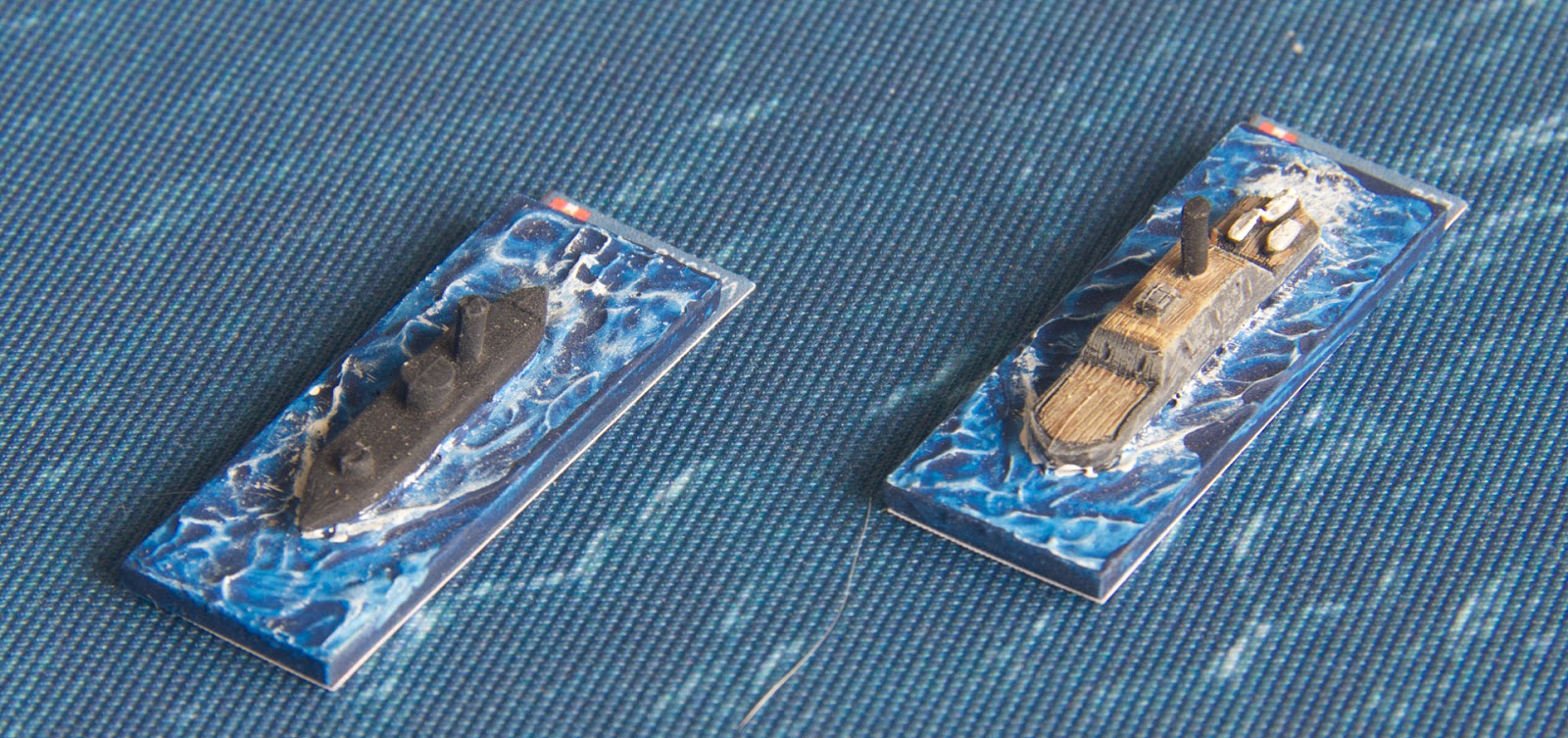
For the Loa I went with CSS Texas (ASV56, comes in a pack with Virginia). It's not a great visual match, but it's a casemate ironclad and it's about the right size. The other option would be CSS Albemarle (ASV60, in a pack with CSS Manassas):
Left: CSS Texas Right: CSS Albemarle
In fact looking at it with fresh eyes, I think the Albemarle is a better match all round.

Unión
Unión
http://translate.google.com/translate?hl=en&sl=auto&tl=en&u=https%3A%2F%2Fes.wikipedia.org%2Fwiki%2FUni%C3%B3n_(corbeta)&sandbox=1
ASV11
ASV11 again. I have no idea why I painted the hull white. I might apply a wash to knock it back to grey.

Talisman
http://translate.google.com/translate?hl=en&sl=auto&tl=en&u=https%3A%2F%2Fes.wikipedia.org%2Fwiki%2FTalism%C3%A1n_(transporte)&sandbox=1
An iron hulled merchant steamer, 170' long built by Blackwood & Gordon. I can't find any pictures of her, but my guess is she probably looked a bit like these (same builder, similar sizes):
Tasman 1873
Wellington 1863
I don't think there's anything really suitable in the TD range. It might be possible to do a bit of radical surgery on ASV15. Here's one with the masts replaced in the original schooner rig, which could just as easily be made 2 masted with a new funnel placed amidships:
ASV15, rig removed and replaced with wire
Not ideal though. I'll wait to see what Hallmark's merchant steamer looks like.

Pilcomayo

 
Pilcomayo

http://translate.google.com/translate?hl=en&sl=auto&tl=en&u=https%3A%2F%2Fes.wikipedia.org%2Fwiki%2FCa%C3%B1onera_Pilcomayo&sandbox=1

Another ASV15 for this one. Shame about the rig, I might try and replace it, but I can probably live with it and life is short.
ASV15
Again, not sure what I was thinking with that paint scheme!

Chalaco, Limeña, Oroya

http://translate.google.com/translate?hl=en&sl=auto&tl=en&u=https%3A%2F%2Fes.wikipedia.org%2Fwiki%2FChalaco_(transporte)&sandbox=1

https://translate.googleusercontent.com/translate_c?depth=1&hl=en&rurl=translate.google.com&sl=auto&sp=nmt4&tl=en&u=https://es.m.wikipedia.org/wiki/Lime%25C3%25B1a_(transporte)&xid=17259,15700023,15700186,15700190,15700259,15700271,15700302&usg=ALkJrhiJOTl2c1FwF6yZ7jBWJLYUpKI1hw

http://translate.google.com/translate?hl=en&sl=auto&tl=en&u=https%3A%2F%2Fes.wikipedia.org%2Fwiki%2FOroya_(transporte)

These were all iron hulled paddle steamers bought at various different times from the Pacific Steam Navigation Company. After a bit of searching on clydeships.co.uk, I think this might be the Chalaco:
Quito - was this the ship bought from the PSNC and renamed Chalaco?
Given the limited options available, there's a choice of two models for these. ASV12 is probably a better size but has three masts instead of two. ASV16 is too small, but has a more appropriate rig:
Left: ASV16              Right: ASV12
I'd intended to use ASV12, but the more I look at it the less happy I am about the rig. I think the plan will be to attempt some drastic conversion work, and if that fails just use ASV16 and pray the Naval Wargames Police don't come for me in the night.

Gunboats


I've been using ASV13 "Screw Gunboat x3" for the Peruvian harbour defence boats, but I might check out Hallmark's range as well.

Torpedo Boats
ASV90 & ASV91 I don't know which boats belong to which packs, sorry.
A pack each of ASV90 "Spar Torpedo Boats & Davids x6" and ASV91 "HMS Lightning & 2nd Class Torpedo Boats x6" pretty much covers the small stuff for both sides. If you want to be absolutely sure a 2nd pack of ASV91 might be necessary for all the Chilean boats. You can even use one of the "Davids" as the Peruvian submersible Toro - you won't ever use it because it's treated in an abstract way in the rules, but fun to have nevertheless.

By the way, let me know if you have any trouble with those Google Translate links - I've just noticed they don't seem to work on my ipad.

Thursday, 30 January 2020

Ships for the War of the Pacific - Part 1 Chile

I've recently returned to a project that's been on the back burner for a while: The War of the Pacific 1879-84 using Dahlgren & Columbiad with the War of the Pacific supplement. The hurdle was trying to find information on the various ships, and then finding suitable substitutes in the Tumbling Dice 1/2400 range.

Recently there seems to be a bit of a surge, or at least a simmering, of interest in the period, and I've been struggling with a mammoth Dutch Wars project, so perhaps it's time to take a break from that and take another run at la Guerra del Pacifico.

I've gone round and round in circles, and have about 30 tabs open in my browser, mostly in Spanish, and there are still bits I'm none the wiser about! Lot's of fudging, guessing and handwaving here, so don't take any of this as gospel, and particularly don't count on my paint schemes - many of these are generic placeholders till I work out what I'm doing.

Chile

Blanco Encalada & Almirante Cochrane

Code: ASV62. I replaced the sails with yards and furled sails, but I wish I'd cut down the masts, or replaced them, and added shrouds. I might have another go at these one day.

O'Higgins & Chacabuco
https://en.wikipedia.org/wiki/Chilean_corvette_O%27Higgins_(1866)

These are wooden hulled screw corvettes. Don't be fooled by TD's descriptions - "ASV15 Screw Corvette x2" are actually smaller ships with a schooner rig. "ASV11 Screw Sloop x1" is more what I'd consider a corvette.
ASV11 "Screw Sloop"
Code: ASV11. On the left is a rather brutal attempt at mast surgery to try and depict the ship under steam. The one on the right is the model as it comes.

Abtao

https://en.wikipedia.org/wiki/Chilean_corvette_Abtao
Another corvette, built about the same time.
Code: ASV11

Esmeralda
https://en.wikipedia.org/wiki/Chilean_corvette_Esmeralda
Tricky one this. Just over half the displacement of the Abtao, but only a few feet shorter. I think the least bad fit would be another ASV11, but could also be ASV15 maybe?


Magallanes
ASV15 "Screw Corvette"
https://en.wikipedia.org/wiki/Chilean_corvette_Magallanes_(1873)
An iron hulled gunboat 200' long. I'm using ASV15.

Covadonga
http://translate.google.com/translate?hl=en&sl=auto&tl=en&u=https%3A%2F%2Fes.wikipedia.org%2Fwiki%2FGoleta_Covadonga
I'm going with another ASV15 for this one, although she's quite a bit smaller than the Magallanes. The other option would be to use the "ASV13 Screw Gunboat x3", but I'm keeping those to be the Peruvian harbour defence boats.

Toltén
http://translate.google.com/translate?hl=en&sl=auto&tl=en&u=https%3A%2F%2Fes.wikipedia.org%2Fwiki%2FVapor_Tolt%25C3%25A9n
A French built paddle steamer with an iron hull. I've written in my notes 130' long, but I can't actually remember where I got that figure from! There's a choice of 3 different sized paddle steamers in the TD range:
From left to right: ASV14 Paddle Gunboat, ASV16 Paddle Corvette, ASV12 Paddle Sloop
Assuming that 130' length is correct, the model would be somewhere between ASV14 and ASV16 - about 16mm. I've gone with the ASV14, with some of my brutal mast hacking. ASV16 might be a better size to be honest, but the funnel's in the wrong place. I'm not sure I care enough to do the conversion!

Angamos
http://translate.google.com/translate?hl=en&sl=auto&tl=en&u=https%3A%2F%2Fes.wikipedia.org%2Fwiki%2FTransporte_Angamos

Here's where it gets tricky. An iron hulled steamer with the funnel set back, and a bloody great 8" Armstrong pivot. The photo above is the only one I can find, but she pops up in a watercolour in Rudolf de Lisle's diary:
It looks like she has a wheelhouse amidships and the gun mounted just forward, with the sides cut away to allow the gun to fire. 235' long makes her about 30mm in scale. I can't find anything in the TD range that is even close. I'm stumped, any ideas anyone?

Amazonas, Rimac and Loa
Amazonas
http://translate.google.com/translate?hl=en&sl=auto&tl=en&u=https%3A%2F%2Fes.wikipedia.org%2Fwiki%2FTransporte_Amazonas
Rimac or Loa?
http://translate.google.com/translate?hl=en&sl=auto&tl=en&u=https%3A%2F%2Fwww.armada.cl%2Farmada%2Ftradicion-e-historia%2Funidades-historicas%2Fr%2Ftransporte-rimac%2F2014-02-14%2F104847.html
http://translate.google.com/translate?hl=en&sl=auto&tl=en&u=https%3A%2F%2Fwww.armada.cl%2Farmada%2Ftradicion-e-historia%2Funidades-historicas%2Fl%2Fvapor-loa-1%2F2014-02-14%2F103930.html

I've lumped these three together because, although they had different armament, they all appear to be a very similar British merchant steamer design, about 290' long (37mm in scale). Rimac and Loa always seem to crop up on the web as the same photo. The only ship in the TD range that comes even vaguely close is ASV22 Merchant Steamer Great Britain:
...but no. Way too long at about 44mm, and with a few too many masts! I guess you could try hacking off all those masts, but the sails are moulded to the hull, so that's a lot of hacking and I'm not sure you'd be left with anything pretty. Stumped again.

I think I might take a look at Hallmark's 1/2400 range for the Lissa period. They do a merchant steamer which might be a better fit, and they also have a few corvettes and gunboats that might be worth looking at.

Monday, 12 August 2019

INWarD 2019 - Battle of Pacocha 1877


In honour of International Naval Wargames Day, which was last Tuesday, I was all set to do a recreation of the Battle of Pacocha, when it became obvious that my tatty bits of green felt were a somewhat inadequate representation of the Atacama desert. So I put the ship models aside and set to sploshing paint on some bits of polystyrene coastline that had been sitting in the cupboard for 6 months or so. They're a bit of a rush job, but hopefully are a more fitting tribute to the memory of Fred T Jane than the felt was at least. This meant I was a little late getting the game played, but better late than never.

Background

On 6 May 1877 supporters of the political exile Nicolas de Pierola seized the Peruvian ironclad Huascar at Callao and sailed her south. The aim was to pick up their leader in Chile and return with him to Peru, where they hoped to incite a popular rebellion. This was Pierola's third attempt at a coup, and it wouldn't be his last.

On their way the Pierolistas started interfering with British merchant steamers, boarding them and seizing Peruvian government mail, and 'requisitioned' 69 tons of coal from a British barque at Pisagua. The Peruvian government effectively decreed the rebels to be pirates, and under pressure from British merchants the Royal Navy were called in to deal with the situation.

Rear-Admiral Algernon Frederick Rous de Horsey, British C-in-C Pacific Station, aboard the unarmoured iron frigate Shah, in company with the wooden screw corvette Amethyst spotted the Huascar off Punta Coles near the port of Pacocha on the afternoon of 29 May. The Shah's first lieutenant was sent in a cutter with a demand for the ship's surrender. Pierola politely told him where to stick it, and after allowing the British officer to leave and giving his men a rousing speech, the Huascar made a dash for the shallow waters off Pacocha and Ilo.

The Rules

I've been tinkering with a hex-based conversion of Dahlgren and Columbiad. D&C are an excellent set of rules - highly streamlined for fast play, but still retaining the essential characteristics of ironclad-era warfare. The main reason for using hexes is that, while the game works perfectly fine without them, in 1/2400 scale things can get a little fiddly and prone to error. Using hexes removes the need for measuring ranges and arcs, and if you accidentally knock one of the models it's easy to put it back where it was. Also, I had a 2" hex mat that I needed to find a use for!

I've changed the way movement phases work. There are six phases in each turn, and each ship activates one at a time, moving either 0, 1 or 2 hexes depending on their speed, and then immediately conducts gunnery before moving on to the next ship. All ships have a numbered counter displaying their speed at the stern - at some point I'll make up some nice wake effect numbered markers.

I've also re-designed the ship record charts to try and condense the information into a smaller space. I've made them standard playing card size, so I can put them in card sleeves and use a dry erase marker to record damage.

The Ships

Huascar is a British-built ironclad turret ship, with 2x10" muzzle-loading rifles in a turret able to fire to port and starboard, a 40lb smoothbore on each beam, and a 12lb SB aft.

She is well armoured with an AF of 5 and has a reinforced ram bow.

She is undermanned, and is suffering from mechanical issues with the turret. A D6 is rolled at the start of every turn - on a 5,6 the turret is out of action that turn.

Her shallow draught allows her to move within 2 hexes of land without risk of running aground.

Shah is a large unarmoured iron frigate, armed with 2x9" MLRs mounted fore and aft, and 14x7" MLRs in the broadsides. She also had some 64 pdrs which I've not included - they could only fire common shell, and I reckon the 7" are the most important factor in the broadside effect.

She also carries eight Whitehead torpedoes which can be launched from either side of the bow. I didn't get to use these, but historically this battle was the first ever use of a locomotive torpedo.

Very fast with a speed of 16 knots, but lacking protection - she only gets an AF of 1 for the iron hull. She can move within 8 hexes of land without risk.


Amethyst is a wooden screw corvette with seven 64lb MLRs in each broadside. I've probably given her slightly higher gun factors than she deserves, but even so she'll need some very lucky dice to cause any damage.

She can move closer inshore than the Shah, but not quite as close as Huascar - 3 hexes without risk.


 Setup

A view of the whole table looking south.

Ilo and Pacocha. The British are not allowed to shoot if their line of fire intersects either town. Both towns have garrisons that will take pot shots at the Huascar if she comes close enough.

Starting positions. Huascar and Shah start at speed 2, Amethyst at speed 4. Ships may accelerate/decelerate 2/4 at the start of each turn, and may also lose speed during turn due to tight manoeuvres or damage effects. There are 20 turns till nightfall.

Victory Conditions

Rebels win if:
Huascar survives with less than Severe damage for 20 turns.
Shah suffers Severe damage.

British win if:
Huascar suffers Severe damage.
Huascar leaves the table.

The game is a draw if the Amethyst is wrecked and the British player would otherwise have won. When I say 'draw' I mean for the purposes of this game only. I'm pretty sure the Admiralty wouldn't have considered the loss of one of their ships a 'draw'. 'Both sides lose' is probably a better term than 'draw'!

The Game

Turns 1&2: Huascar makes a dash for the shallows, with Shah in pursuit and Amethyst closing in. Shah opens fire at the Huascar, hitting but causing no damage. Huascar's turret is out of action for most of the early turns.

Turn 3: Amethyst engages Huascar at close range while Shah stays in deeper water.


Turns 4&5: The Pierolistas try to keep the port behind them to force the British to check their fire. On Turn 4 Shah's aft 9" hits the Huascar causing temporary steering loss, forcing her to move down the coast towards Ilo.


Turn 6: As Huascar steams close to the shore, the Ilo garrison shoots at her from the beach


Turn 7: Huascar's aft 12 pdr damages Amethyst causing temporary steering loss.

Turns 7-9: Shah and Huascar score several hits on each other during this period, but fail to inflict any significant damage. Both British ships are occasionally forced to check their fire to avoid hitting the town.
Not only was this battle the first use of a torpedo, it was also the first use of the Laser Death Ray.


Turn 10: The Shah is hit by Huascar's 10" MLRs resulting in hull damage. Although this has no immediate effect on her fighting ability, it makes her significantly easier to damage from now on, and her lack of armour could prove to be problematic.

Turns 10-12: Emboldened by their success, and noticing that the Shah has reduced her speed in order to manoeuvre, the rebels break from the cover of the shallows and try to set up a ram. Shah evades easily and hits the Huascar with her port 7" guns, jamming her rudder once again. Huascar retreats back towards the shore.


Turn 13: Huascar swings round, pursued by Amethyst, and once again the Ilo garrison lends their support from the beach. Their enthusiasm is admirable, but the effect is negligible.


Turns 14&15: Irritated by the the Amethyst's constant harassment, the Pierolistas try to line up for a ram. As they close, Amethyst's decks are swept by gatling fire, supressing the gunners. Huascar mistimes the ram, and both ships bump and scrape suffering no ill effects.


Turn 16: Shah takes another 10" hit, further weakening her hull and reducing her DF to only 2. It's now de Horsey, rather than Pierola, who is praying for nightfall.
Shah about to receive a face-full of 10" MLR
Turn 17: Huascar comes out fighting again, and de Horsey signals to Amethyst to withdraw. Shah gets a critical hit on Huascar, permanently damaging her steering. Too little, too late.


Turn 18: As Amethyst attempts to extricate herself, Huascar hits her at point blank range with the port 40lb smoothbore, damaging her hull.

Turns 19&20: As de Horsey withdraws his damaged ships, Huascar hits the vulnerable Shah twice with her smoothbores, reducing her speed and damaging the aft 9". The Pierolistas slip away into the shallows as darkness falls.


Outcome


Both British warships will be out of operation for some time, while the Huascar has escaped relatively unscathed. If the rebels can fix her steering they'll be able to operate with impunity, at least for a while. More importantly, the locals have witnessed a warship proudly flying Peruvian colours beating off an attack by British Imperialist aggressors, and word will spread fast. Nicolas de Pierola's revolution now looks much more likely to succeed.

I was going to do a summary of the historical outcome and aftermath, and suggest some improvements to the scenario that could be made, but to be honest I've already spent far more time on this little project than I'd intended. I'm afraid I've run out of steam, if you'll pardon the pun.

If you're interested in reading more, I heartily recommend Ironclads at War by Jack Greene and Alessandro Massignani.